Reviewed by Jo Lyall, Nutritional Therapist (Dip Nut, mBANT, CNHC) and Dr Shahzadi Harper, Resident Doctor at The Better Menopause
If your weight has crept up in your 40s and the things that used to work have stopped working, you are not imagining it. Around 50% of women report gaining weight in perimenopause, with research suggesting an average gain of 1.5kg per year through this transition. The frustrating part is that the same diet, the same exercise and the same routines that held things steady in your 30s now seem to deliver the opposite result.
This is not a willpower problem and it is not just ageing. Perimenopause changes your metabolism at a hormonal, cellular and inflammatory level. Once you understand what is actually happening, the right interventions become much clearer. Here we look at why perimenopause causes weight gain, the role of inflammation and blood sugar in midlife, and the practical steps that genuinely help.
Key takeaways
- Perimenopause weight gain has clear hormonal and metabolic causes. The same habits that worked in your 30s interact differently with a midlife hormonal environment.
- Declining oestrogen reduces insulin sensitivity, redistributes fat to the abdomen, and triggers a rise in chronic low-grade inflammation.
- Midlife inflammation is a key driver of weight gain, joint pain, brain fog and long-term cardiovascular risk, and is increasingly recognised as central to midlife metabolic health.
- The gut microbiome plays a direct role through the estrobolome, the gut bacteria that help metabolise oestrogen, and through its effect on inflammation and blood sugar regulation.
- Practical steps that help include protein at every meal, strength training, gut support, blood sugar balance, sleep, and targeted supplementation including berberine, myo-inositol, cinnamon and chromium.
In this article
How perimenopause changes your metabolism
The familiar message about weight is that it comes down to calories in and calories out. That is true at the simplest level, but it leaves out the hormonal and metabolic environment those calories are landing in. Perimenopause changes that environment in several ways at once.
Oestrogen, fat distribution and metabolic rate
Oestrogen does far more than regulate the menstrual cycle. It plays a direct role in how your body stores fat, manages glucose, and burns energy at rest. As oestrogen levels fluctuate and decline through perimenopause, three things tend to happen.
First, fat redistributes. Pre-menopause, women typically store fat around the hips and thighs. As oestrogen falls, the body shifts towards storing fat around the abdomen instead. This visceral fat is metabolically active, meaning it produces inflammatory signals of its own and is linked to higher risks of insulin resistance, type 2 diabetes and cardiovascular disease.
Second, your basal metabolic rate slows. Research suggests that during perimenopause and menopause, women may burn around 250 to 300 fewer calories per day at rest than they did pre-menopause. Without any change in eating, that creates a slow, steady mismatch.
Third, muscle mass declines. Women lose between 1 and 2% of their muscle mass per year from around the age of 35, and that rate accelerates through the menopause transition. Because muscle is metabolically active tissue, losing it lowers the rate at which you burn calories at rest, which makes weight management substantially harder.
The progesterone factor
Progesterone is often the first hormone to decline in perimenopause, sometimes years before oestrogen. As progesterone falls, sleep tends to suffer, anxiety can rise, and the body's stress response becomes more reactive. All three of these affect weight.
Poor sleep alone is associated with increased hunger, stronger sugar cravings, higher cortisol levels and reduced insulin sensitivity. Combined with the hormonal shifts already underway, this creates a cycle that can be hard to interrupt without addressing each piece.
The inflammation connection in midlife
Inflammation is the part of the perimenopause weight conversation that has historically been missed, and it may be the most important. Recent research has shifted thinking on midlife metabolism almost entirely, recognising perimenopause as a systemic inflammatory phase rather than just a hormonal one.
What is changing, and why
Oestrogen is one of the body's most powerful anti-inflammatory hormones. It regulates the immune system, controls cytokine signalling, and helps keep the inflammatory response in balance. As oestrogen declines, that protective effect fades, and the body shifts into a state of chronic low-grade inflammation.
This is not the acute inflammation you experience after an injury or infection. It is a persistent, low-level inflammatory signal running in the background, affecting almost every system in the body. It contributes to joint pain, brain fog, fatigue, sleep disturbance, mood changes, and cardiovascular risk. And it makes weight management measurably harder.
Why inflammation drives weight gain
Chronic inflammation interferes with insulin signalling, meaning your body becomes less efficient at moving glucose out of the bloodstream and into cells. The pancreas compensates by producing more insulin, which encourages fat storage and makes fat harder to release. This is one of the reasons why a calorie deficit alone often fails to deliver the weight loss it would have produced ten years earlier.
Inflammation also affects appetite-regulating hormones including leptin and ghrelin, which is why hunger cues can feel less reliable in midlife. And inflamed visceral fat tissue produces its own inflammatory signals, creating a feedback loop where weight gain drives more inflammation, which drives more weight gain.
The bigger picture for midlife health
Inflammation in perimenopause matters well beyond the scales. It is linked to higher long-term risks of cardiovascular disease, type 2 diabetes, osteoporosis, and cognitive decline. Supporting your body's ability to manage inflammation in midlife is one of the most useful things you can do for your healthspan, the years you live in good health.
For a deeper look at this, read our guide to the connection between perimenopause and inflammation.
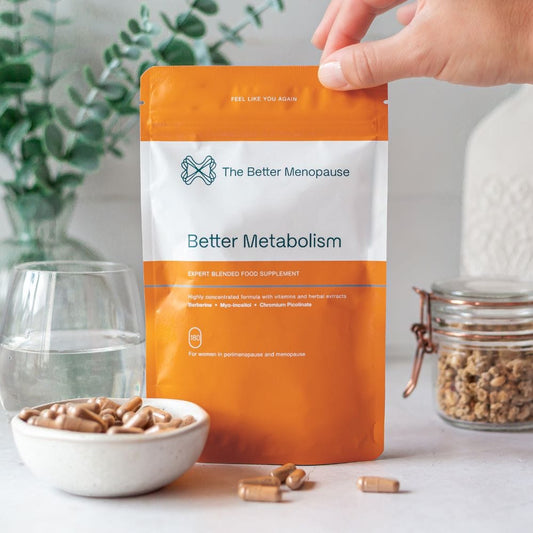
Better Metabolism is formulated with berberine, myo-inositol, cinnamon and chromium picolinate to support blood sugar balance, insulin sensitivity, and the body's response to inflammation in midlife. Find out more →
Blood sugar, insulin and the perimenopause shift
If you have noticed stronger sugar cravings, mid-afternoon energy crashes, or that you feel hungry sooner after meals than you used to, this is the hormonal explanation behind it.
What insulin resistance feels like
As oestrogen declines, cells throughout the body become less responsive to insulin. The pancreas releases more of it to compensate, which means your average insulin levels are higher than they were a decade ago. This is what is meant by insulin resistance, and it has predictable real-world effects.
You may notice that the same lunch that used to keep you full for four hours now leaves you hungry by mid-afternoon. You may find yourself thinking about food more often, particularly carbohydrate-heavy or sugary foods. You may experience a real energy slump in the early afternoon, sometimes accompanied by irritability, brain fog or a desperate need for caffeine. And you may find that fat accumulates around the middle in a way it never used to.
None of this is willpower. It is the hormonal environment changing the way your body responds to food.
The cravings cycle
Falling oestrogen also affects serotonin, the neurotransmitter linked to mood and satisfaction. When serotonin dips, the brain looks for the fastest available source of comfort, and sugar is the quickest fix it knows. Combined with reactive blood sugar dips, this creates a cravings cycle that can feel relentless.
Cortisol plays a role too. Perimenopause makes the stress response more reactive, and elevated cortisol drives the body to seek out high-energy foods as a survival mechanism. So a stressful day at work, a poor night's sleep, or a missed meal can each amplify cravings well beyond what they would have been in your 30s.
The gut-metabolism axis
The gut microbiome plays a much larger role in midlife metabolism than most women have been told. It influences how you metabolise oestrogen, how well you regulate blood sugar, how much inflammation your body produces, and how efficiently you absorb nutrients.
The estrobolome
Your gut contains a specific community of bacteria called the estrobolome, which helps metabolise and recycle oestrogen. When the estrobolome is balanced, oestrogen is processed and cleared efficiently. When the gut microbiome is out of balance, this system becomes less effective, which can amplify hormonal symptoms and contribute to weight gain, mood changes and brain fog.
Hormonal change in perimenopause itself affects the gut microbiome, which means the gut and hormones are influencing each other in both directions. Supporting one helps the other.
Inflammation starts in the gut
Around 70% of the immune system lives in or around the gut, which makes the microbiome one of the largest sources of inflammatory signalling in the body. An imbalanced gut, particularly one with reduced diversity or compromised barrier function, can drive systemic inflammation in ways that show up as joint pain, fatigue, mood changes and weight gain.
Supporting gut health in midlife is therefore not just about digestion. It is one of the most direct routes to lower inflammation, better hormone metabolism, and steadier energy.
What actually helps
The interventions that work in midlife are not the same ones that worked in your 30s, and a lot of standard advice is genuinely outdated. Here are the strategies with the strongest research behind them for women in perimenopause and menopause.
1. Protein at every meal
This is the single most useful nutritional shift most women in midlife can make. Aim for 25 to 30g of protein at each main meal, with breakfast being the most important. Protein supports muscle maintenance, slows the glucose response to carbohydrates, and helps regulate appetite hormones.
Practical examples: two eggs and a slice of sourdough with avocado at breakfast (around 20g protein), a portion of chicken or salmon with vegetables and quinoa at lunch (around 30g), Greek yoghurt with seeds as a snack (around 15g).
2. Strength training
If you do one thing for your metabolism in midlife, make it strength training. Building and maintaining muscle counters the natural decline that accelerates through the menopause transition, supports bone density, improves insulin sensitivity, and produces anti-inflammatory signals through movement itself.
Aim for two to three sessions per week of around 30 to 40 minutes. The dose does not need to be heroic. Consistency matters more than intensity. Bodyweight, resistance bands, or weights at home all work.
3. Support your gut
Eat a wide range of plant foods, aiming for around 30 different plants per week. Include fermented foods such as live yoghurt, kefir, sauerkraut or kimchi. Reduce ultra-processed foods, which research links to reduced microbial diversity and higher inflammatory markers. Consider a targeted probiotic designed for women in perimenopause.
4. Stabilise blood sugar
Pair carbohydrates with protein, fibre and healthy fats to slow the glucose response. Avoid eating carbohydrates on their own, particularly first thing in the morning. Walk for 10 minutes after meals where possible, which can reduce post-meal blood sugar spikes by a real margin. Limit caffeine on an empty stomach.
5. Prioritise sleep
Sleep affects almost every aspect of midlife metabolism, from hunger hormones to cortisol patterns to insulin sensitivity. If sleep is suffering, address it directly. For more on this, see our guide to why perimenopause affects sleep and what helps.
6. Manage stress and cortisol
Cortisol patterns shift in perimenopause, and chronic stress amplifies almost every symptom from sleep to weight to mood. Movement, breathwork, time outdoors, and protected rest all help. This is not optional self-care. It is metabolic intervention.
7. Consider HRT where appropriate
Hormone Replacement Therapy is not licensed as a weight management treatment, but by replacing some of the oestrogen that has declined, it can support insulin sensitivity, reduce inflammation, and improve sleep, mood and energy in ways that indirectly help with weight. Speak to a menopause-informed healthcare provider about whether HRT is right for you. For more on this and other approaches, read our guide to HRT and complementary approaches.
Where supplements fit in for midlife metabolism
Supplements are not a replacement for nutrition, movement or sleep, and no responsible brand should suggest otherwise. They are a layer of targeted support that works best alongside the foundational habits above. For midlife metabolism specifically, four ingredients have research behind them that is worth knowing about.
Berberine
Berberine is a plant compound used for centuries in traditional Chinese and Ayurvedic medicine, with growing research interest in its role in metabolic health. It works by activating AMP-activated protein kinase (AMPK), often described as the body's metabolic master switch. AMPK is also activated by exercise and fasting, and when switched on it encourages cells to shift from energy storage towards energy use, supporting glucose uptake, fat metabolism and mitochondrial function.
Research suggests berberine may support healthy blood sugar levels already within the normal range, improve insulin sensitivity, reduce systemic inflammation through several documented pathways, and support the gut microbiome by encouraging the growth of beneficial bacteria including Akkermansia muciniphila. For a deeper look at the science, read our piece on berberine and menopause.
Myo-inositol
Myo-inositol is a compound your body produces naturally, with a substantial body of research on its role in insulin sensitivity and hormonal balance, particularly in women. It supports insulin signalling at the cellular level and has been studied for its role in metabolic conditions linked to hormonal change.
Cinnamon extract
Cinnamon has a long history of traditional use and a growing research base showing it can support insulin signalling and reduce post-meal blood sugar spikes. This makes it a useful addition for appetite regulation and steady energy through the day.
Chromium picolinate
Chromium contributes to the maintenance of normal blood glucose levels and macronutrient metabolism. It plays a role in glucose transport into cells and may help curb sugar cravings, which is one of the most common challenges in perimenopause.
How long do they take to work
Most research on berberine and similar metabolic supplements points to three months of consistent daily use to see the full effect. Some women notice changes in cravings, energy and digestion within the first few weeks, but the deeper changes to insulin sensitivity, inflammatory markers and metabolic function build over time. Consistency is the key variable.
When to see your GP
Speak to your GP if your weight gain is sudden or substantial, if you have other symptoms that concern you (such as ongoing fatigue, unusual thirst, frequent urination, or changes in bowel habits), or if perimenopause symptoms are affecting your quality of life. It is worth asking about thyroid function, blood sugar markers, vitamin D and iron levels alongside any conversation about hormonal change. A menopause-informed healthcare provider can help you build a plan that fits your individual picture.
The bottom line
Perimenopause weight gain is real, common, and rooted in measurable hormonal, metabolic and inflammatory shifts. It is not a willpower failure, and it does not respond well to the same advice that worked in your 30s. The interventions that genuinely help are the ones that address the underlying biology: protein, strength training, gut health, blood sugar balance, sleep, stress management, and where appropriate, targeted supplementation and HRT.
Small, consistent changes across these areas tend to deliver more than any single intervention. And the wider story matters too. Supporting your metabolism and inflammation in midlife is one of the most useful things you can do for your long-term health, regardless of where the scale lands.
This article is for informational purposes and is not a substitute for professional medical advice. If you have concerns about your weight, metabolism or perimenopause symptoms, please speak to your GP or a qualified healthcare provider.
Related reading
- The connection between perimenopause and inflammation
- Berberine and menopause: a natural ally for weight management
- Menopause, metabolism and how to boost yours
- The estrobolome: how gut bacteria shape oestrogen in midlife
- Why perimenopause affects sleep and what actually helps
- Supplements and natural remedies for menopause weight loss
Support your metabolism in midlife
At The Better Menopause, our supplements are formulated with women in midlife in mind. Better Metabolism combines berberine, myo-inositol, cinnamon extract and chromium picolinate to support blood sugar balance, insulin sensitivity and the body's response to inflammation. Pair with Better Gut, our targeted probiotic, for foundational gut and metabolic support.
Shop Better Metabolism →Meet the author

Featured Supplements
-
Regular priceFrom $50.00Regular priceSale priceFrom $50.00 Save $-50.00 (%)Unit priceper
Better Metabolism
-
Regular priceFrom $50.00Regular priceSale priceFrom $50.00 Save $-50.00 (%)Unit priceper
Better Gut
-
Regular priceFrom $99.00Regular priceSale priceFrom $99.00 Save $-99.00 (%)Unit priceper
Body Bundle