Reviewed by Jo Lyall, Nutritional Therapist (Dip Nut, mBANT, CNHC) and Dr Shahzadi Harper, Resident Doctor at The Better Menopause
If there's one thing most women in perimenopause aren't getting enough of, it's protein. Not because they don't eat well, but because the amount their body needs has quietly increased at exactly the point when most of us aren't thinking about it.
Protein isn't just for gym-goers and bodybuilders. During perimenopause, it's one of the most effective nutritional tools you have for protecting muscle mass, supporting your metabolism, stabilising blood sugar, keeping cravings in check and strengthening your bones. And most women are falling short without realising it.
In this article, we break down how much you actually need, why it matters more now than it did ten years ago, and how to hit your target without turning every meal into a maths problem.
Key takeaways
- The standard protein recommendation (0.8g per kg of body weight) is a minimum to prevent deficiency, not an optimal target for midlife women.
- During perimenopause, aim for 1.0 to 1.6g of protein per kg of body weight per day, depending on your activity level.
- Spreading protein across meals in portions of 25 to 30g is more effective for muscle maintenance than eating it all in one sitting.
- Protein supports muscle mass, bone density, blood sugar regulation, satiety, mood and metabolic rate during perimenopause.
- Both animal and plant sources count. The key is consistency and quantity, not perfection.
In this article
- Why protein matters more during perimenopause
- How much do you actually need?
- Why timing matters: the 25 to 30g rule
- What 25 to 30 grams of protein actually looks like
- Protein, muscle and your metabolism
- Protein, blood sugar and cravings
- Protein and bone health
- Plant protein vs animal protein
- Practical tips for hitting your protein target
- The bottom line
Why protein matters more during perimenopause
Your protein needs don't stay the same throughout your life. During perimenopause, several things happen at once that make protein more important than it's ever been.
Muscle breakdown increases. Declining oestrogen directly affects muscle protein synthesis, your body's ability to build and repair muscle tissue. At the same time, muscle protein breakdown accelerates. The result is a gradual loss of lean muscle mass, known as sarcopenia, which begins during perimenopause and continues after menopause if left unaddressed.
Your metabolism slows. Muscle is metabolically active tissue, meaning it burns energy even when you're resting. As you lose muscle mass, your resting metabolic rate drops. Research suggests women need roughly 100 fewer calories per day after menopause purely because of changes in body composition. Adequate protein, combined with strength training, helps preserve the muscle that keeps your metabolism working.
Body composition shifts. Even without changes in weight, many women notice their body shape changing during perimenopause: more fat stored around the middle, less definition in arms and legs. This isn't about eating too much. It's a hormonal redistribution of where your body stores fat and how efficiently it uses energy. Protein is one of the most effective tools for slowing this shift.
Blood sugar becomes less stable. Oestrogen helps regulate insulin sensitivity. As it fluctuates during perimenopause, your body becomes less efficient at managing blood sugar, leading to energy crashes, cravings and that mid-afternoon slump. Protein at every meal helps stabilise glucose levels and keeps energy more consistent throughout the day.
How much do you actually need?
The UK government RDA for protein is 0.75g per kilogram of body weight per day. But this is the minimum amount needed to prevent protein deficiency in an average adult. It's not a target for optimal health, and it's certainly not enough for a woman going through perimenopause.
Current research suggests that women in perimenopause and menopause should aim for 1.0 to 1.6g of protein per kilogram of body weight per day, depending on how active they are.
Here's what that looks like in practice:
If you weigh around 60kg (roughly 9.5 stone): aim for 60 to 96g of protein per day.
If you weigh around 70kg (roughly 11 stone): aim for 70 to 112g of protein per day.
If you weigh around 80kg (roughly 12.5 stone): aim for 80 to 128g of protein per day.
The lower end (1.0g/kg) is appropriate if you're relatively sedentary. The higher end (1.2 to 1.6g/kg) applies if you're regularly doing strength training, high-intensity exercise or actively trying to build muscle. Most women in perimenopause would benefit from aiming for at least 1.2g/kg as a starting point.
For context, the average protein intake for UK women is around 64g per day. If you're a woman in your 40s or 50s, there's a good chance you're falling short of what your body now needs.
Supporting your metabolism during perimenopause
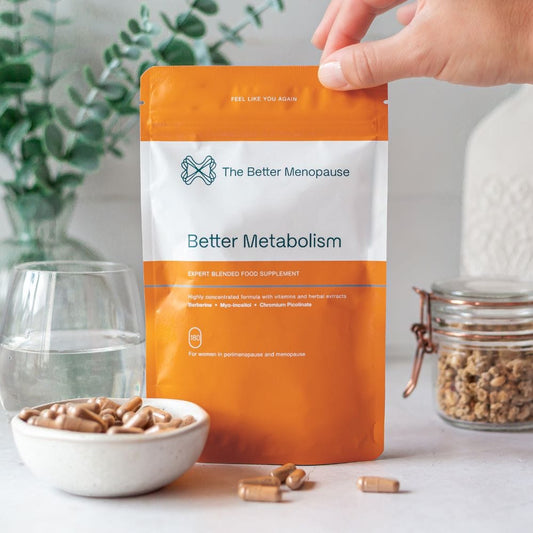
Alongside adequate protein, targeted supplementation can support metabolic function during midlife. Better Metabolism combines berberine, cinnamon, chromium and myo-inositol to support blood sugar balance, reduce cravings and help your body use energy more efficiently.
Why timing matters: the 25 to 30g rule
It's not just about total daily protein. How you distribute it across the day makes a real difference to how effectively your body uses it.
Research shows that muscle protein synthesis (the process of building and repairing muscle) is most effectively stimulated when you consume 25 to 30g of protein in a single meal. Your body can only use a certain amount of protein for muscle building at one time. Eating 10g at breakfast, 10g at lunch and 60g at dinner is less effective than spreading 25 to 30g across three meals, even though the total is the same.
This is where many women fall short. Breakfast is often the weakest protein meal of the day: a piece of toast, a bowl of cereal, a banana on the go. By the time you get to dinner, you're trying to cram your entire daily protein target into one sitting, which your body can't fully use.
The fix is simple: front-load your protein. Make breakfast and lunch do more of the heavy lifting, and dinner can take care of itself.
What 25 to 30 grams of protein actually looks like
This is the question everyone asks, because grams don't mean much until you can picture them on a plate. Here are some examples of what roughly 25 to 30g of protein looks like from a single source:
- A palm-sized portion of chicken breast (120 to 150g cooked)
- A palm-sized portion of salmon or white fish (140 to 150g cooked)
- 3 large eggs (scrambled, poached or in an omelette)
- 200g Greek yoghurt plus a small handful of nuts
- 1 tin of chickpeas (drained, roughly 240g)
- 150g firm tofu plus a serving of quinoa
- 100g cooked lentils plus 2 slices of sourdough bread
- 60g hard cheese (such as cheddar or parmesan)
- A large bowl of lentil or bean soup with a slice of bread
In practice, most meals will combine several sources. An omelette with feta and a side of yoghurt. A chicken salad with chickpeas and seeds. A bowl of dal with rice and a dollop of natural yoghurt. You don't need to hit 30g from a single food: combinations work just as well.
Protein, muscle and your metabolism
The relationship between protein, muscle and metabolism during perimenopause is one of the most important nutritional connections to understand.
Muscle is your body's largest metabolic organ. The more muscle mass you have, the more calories you burn at rest. During perimenopause, as oestrogen declines and muscle breakdown increases, you can lose up to 1% of your muscle mass per year if you don't actively work to maintain it. Over a decade, that's a significant drop in metabolic rate and a significant shift in body composition.
Protein and strength training work together to slow this process. Protein provides the building blocks (amino acids) your muscles need to repair and rebuild. Strength training provides the stimulus that tells your muscles to use those building blocks. Without enough protein, strength training alone won't produce its full benefits. Without strength training, protein alone won't fully protect your muscle mass.
The good news, as a recent study published in Menopause journal confirmed, is that perimenopause is actually the period when your metabolism is most flexible and most responsive to these changes. Your body is ready to respond. It just needs the right inputs.
Protein, blood sugar and cravings
If you've noticed your sugar cravings getting worse during perimenopause, protein is one of the most effective ways to manage them.
Protein slows the rate at which glucose enters your bloodstream after a meal. This means fewer blood sugar spikes, fewer crashes, and fewer of those 3pm moments where you'd do anything for a biscuit. It also increases satiety hormones (particularly peptide YY) and reduces ghrelin, the hormone that tells your brain you're hungry. In other words, protein helps you feel fuller for longer and reduces the hormonal signals that drive overeating.
During perimenopause, when fluctuating oestrogen makes blood sugar regulation less stable, this effect becomes even more important. A breakfast with 25 to 30g of protein can change the entire trajectory of your energy and appetite for the rest of the day.
Protein and bone health
Protein doesn't just support muscle. It's also essential for bones. Around 50% of bone volume is made up of protein, and dietary protein provides the structural framework (the bone matrix) that minerals like calcium attach to.
During perimenopause and after menopause, bone density declines as oestrogen drops. Adequate protein intake, combined with weight-bearing exercise and sufficient calcium and vitamin D, is one of the key dietary strategies for protecting bone health during this transition.
There's a persistent myth that high protein intake is bad for bones because it "leaches calcium." Research has consistently shown this isn't true. In fact, higher protein intake is associated with better bone density and lower fracture risk in postmenopausal women, provided calcium intake is adequate.
Plant protein vs animal protein
Both count, and both have their strengths. You don't need to eat meat to meet your protein targets during perimenopause, but plant-based diets do require a bit more planning.
Animal proteins (meat, fish, eggs, dairy) are "complete" proteins, meaning they contain all nine essential amino acids in the proportions your body needs. They're also more concentrated, so smaller portions deliver higher protein. A 120g chicken breast provides roughly 30g of protein. You'd need about 300g of cooked lentils to get the same amount.
Plant proteins (legumes, beans, lentils, tofu, tempeh, nuts, seeds, grains) are generally lower in one or more essential amino acids, but combining different sources across the day gives you a complete profile. You don't need to combine them at every single meal; your body pools amino acids over the course of the day.
Soy products (tofu, tempeh, edamame) deserve a special mention during perimenopause. They're one of the few complete plant proteins and they contain phytoestrogens (plant compounds that can weakly mimic oestrogen), which some research suggests may help with certain perimenopause symptoms.
The key isn't choosing one over the other. It's making sure you're consistently hitting your daily target from whatever sources work for your body and your lifestyle.
Your gut affects how well you absorb protein
A healthy gut lining is essential for absorbing nutrients from your food, including amino acids from protein. Better Gut contains six clinically studied probiotic strains formulated for women in perimenopause and menopause, supporting digestion and nutrient absorption.
Practical tips for hitting your protein target
1. Start with breakfast
This is where most women fall short. Swap toast or cereal for eggs, Greek yoghurt with nuts and seeds, or a smoothie with protein powder, nut butter and oats. Aim for 25 to 30g at breakfast and the rest of the day becomes much easier.
2. Add protein to snacks
Instead of reaching for a biscuit or a piece of fruit alone, pair it with a protein source. Apple slices with nut butter. Oatcakes with hummus. A handful of nuts and a piece of cheese. Small additions across the day add up quickly.
3. Batch cook protein sources
Roast a tray of chicken thighs, cook a big pot of lentils, or hard-boil a batch of eggs at the start of the week. Having protein ready to go in the fridge removes the friction of having to prepare it at every meal.
4. Don't forget the sides
Seeds, nuts, cheese, yoghurt and legumes can turn a low-protein meal into an adequate one. A salad with just leaves and vegetables might have 5g of protein. Add chickpeas, feta and pumpkin seeds and it's closer to 25g.
5. Read labels
If you're buying ready meals, soups or snacks, glance at the protein content. Anything below 15g per serving is probably not doing enough to support your protein target. This isn't about obsessing over numbers. It's about building awareness of what your food is actually giving you.
6. Don't overthink it
You don't need to weigh everything or track every gram. Once you know what 25 to 30g looks like on a plate, you can eyeball it. A palm-sized portion of meat or fish, three eggs, a generous serving of legumes with a grain. Get that at each meal and you're most of the way there.
Related reading
The bottom line
Protein is not a trend. It's one of the most practical, effective things you can prioritise during perimenopause. It protects your muscles, supports your bones, stabilises your blood sugar, keeps your metabolism working and helps you feel fuller and more energised throughout the day.
You probably need more than you're currently eating. The good news is that it doesn't require a complete overhaul. Start with breakfast, aim for 25 to 30g per meal, and build from there. Your body will do the rest.
Support your metabolism during perimenopause
Alongside adequate protein, targeted supplementation can support metabolic function during midlife. Better Metabolism combines berberine, cinnamon, chromium and myo-inositol to support blood sugar balance, reduce cravings and help your body use energy more efficiently.
Shop Better Metabolism →Meet the author

Discover our award-winning formulations
-
Regular priceFrom $50.00Regular priceSale priceFrom $50.00 Save $-50.00 (%)Unit priceper
Better Metabolism
-
Regular priceFrom $99.00Regular priceSale priceFrom $99.00 Save $-99.00 (%)Unit priceper
Body Bundle