We explore the links between menopause and hair loss, some treatments that could help and when your hair might grow back naturally.
Shedding hair is a normal part of the cycle of hair growth, but if you’re noticing more significant hair loss than usual, hormonal changes due to the menopause transition could be a contributing factor.
Below, we’ll look at what’s behind this, the symptoms you might experience and some specific hair loss conditions that can be more common after menopause. Hair lost due to the menopause often grows back but outcomes can depend on exactly what is causing your hair loss.
We’ll also explore some of the medical treatments and other approaches that could help to slow hair loss and improve the health of your hair.
Normal hair growth and loss
A degree of hair loss is a normal part of the hair growth cycle. You’ll generally shed around 100–150 strands each day as part of this process. Before we look at the effects of menopause on hair loss, it’s helpful to understand this cycle.
Your hair goes through four main phases of growth. Individual hair follicles are at different points in this cycle at any given time.
- Growth (anagen): The growth phase for scalp hair lasts for two to six years. As you get older. this phase gets shorter, with fewer follicles involved, resulting in weaker and thinner hair.
- Regression (catagen): In this phase, lasting two to four weeks, your hair follicles stop growing and detach from the blood supply beneath your scalp.
- Resting (telogen): Existing hair enters a dormant stage lasting two to three months while new hair begins to develop at the base of the hair follicle.
- Shedding (exogen): As the telogen phase ends, new hair grows upward, pushing the old hair out of the follicle, resulting in natural hair loss.
Does menopause cause hair loss?
Thinning hair is more common during and after the menopause transition than in premenopausal women and there’s good evidence that hormonal changes at this time play a part in increased hair loss.
Your hair follicles contain receptors for reproductive hormones including oestrogen, progesterone and testosterone, all of which are involved in your hair’s natural growth cycle.
During perimenopause – the years leading up to menopause – your levels of oestrogen and progesterone go up and down. In post-menopause – the time 12 months after your last period – these hormones settle at their lowest levels.
While testosterone declines gradually with age, lower oestrogen levels can lead to a higher ratio of testosterone to oestrogen during or after the menopause transition.
These different hormonal imbalances can result in hair strands becoming thinner and more brittle. They can also reduce the blood supply to follicles, slowing the biological processes essential for hair growth.
As the growth of new hair slows down, old hair can continue to shed, leading to sparser hair coverage. You may notice a general thinning of the hair across your head, or a widening of your parting.
Hair loss conditions
Several specific hair loss conditions are also more common in postmenopausal women. Although the exact causes of these forms of hair loss are not fully understood, both ageing and menopausal hormonal changes can be contributing factors:
- Telogen effluvium (TE): Hair loss from TE occurs across the entire scalp. It can be acute – happening over a few months before resolving itself – or chronic, where it’s more persistent. You may notice more hair than usual on your hairbrush or in the shower drain.
- Female pattern hair loss (FPHL): FPHL is the most common cause of hair loss in women. It usually involves thinning of the hair on the top of the scalp, rather than the frontal hairline, but it can also affect the temples and sides of the scalp.
- Frontal fibrosing alopecia (FFA): FFA is an inflammatory disease that destroys hair follicles. It generally affects post-menopausal women. Hair loss is usually around the hairline, where it can be accompanied by an itching or burning sensation, but sometimes also involves the eyebrows, arms and legs or pubic area.
Does hair loss from menopause stop and will it grow back?
There’s not much specific clinical research into when menopause hair loss ends or whether lost hair grows back. But we can look at the mechanisms behind hair loss, and anecdotal evidence from women who have experienced it, to try to address these questions.
One thing that’s clear is that everyone is different, and one woman’s experience may not be the same as another’s. However, some women report menopause hair loss stopping or slowing down after their periods finish, with some saying it can start up again later on.
If your hair loss is caused by fluctuations in hormone levels during perimenopause, it could make sense that it would stop or improve after menopause when levels stabilise.
On the other hand, low oestrogen has also been linked to hair loss, which might explain why some women experience it after menopause or why it returns later on when oestrogen levels hit their lowest point.
The good news is that hair loss caused only by hormonal changes due to menopause does not generally destroy hair follicles, meaning there is always the possibility of hair regrowing. Many women do report hair growing back after menopause hair loss, although they sometimes say it can be thinner and more brittle.
Specific hair loss conditions
As we’ve seen, hormonal changes due to menopause may also contribute to more specific types of hair loss. In these cases, whether hair lost stops, or hair grows back, will depend on the particular condition.
If your hair loss is due to telogen effluvium (TE), it will usually clear up without any treatment. New hair will start to regrow after 3 to 6 months, returning to its normal volume and thickness some months later.
With female pattern hair loss (FPHL), hair follicles begin to shrink until they eventually stop producing hairs. While there is no cure for FPHL, there are treatments that can significantly slow its progression (see section below).
Frontal fibrosing alopecia (FFA) can destroy hair follicles around the hairline. Once this happens, hair can’t grow back. But there are treatments that can help to slow or stop hair loss for some people (see below).
Menopause hair loss treatments and remedies
There are several medications that may help to improve symptoms for women experiencing telogen effluvium or female pattern hair loss related to the menopause, although they’re not all necessarily easy or cheap to get hold of.
We’ll also look at some of the best shampoos to treat hair loss and the part that diet and food supplements can play.
Minoxidil
Minoxidil is a drug that widens blood vessels. It’s usually used to treat high blood pressure.
Applied directly to your scalp as a solution, minoxidil increases the blood flow to hair follicles. It may slow the progression of FPHL and can even help hair to grow back for some women. It may also sometimes be used to manage FE.
Minoxidil is not available on an NHS prescription as a hair loss treatment, and it’s expensive to buy, but it can be used under the guidance of a healthcare professional.
Antiandrogens
These drugs – including finasteride, dutasteride, spironolactone, cyproterone acetate, flutamide and bicalutamide – block the actions of testosterone and related hormones that can contribute to FPHL (also known as androgenic alopecia) and FFA.
Although they’re not licensed in the UK to treat these conditions, your doctor may be able to prescribe them under certain circumstances.
Hormone replacement therapy (HRT)
Hormone replacement therapy uses tablets, skin gels or patches to replenish hormones like oestrogen and progesterone that are reduced due to menopause. HRT is an effective treatment for many common menopause symptoms but when it comes to hair loss, the evidence is mixed.
Some small clinical studies suggest oestrogen replacement might help reduce hair loss, while others have found that it doesn’t have a significant effect and that treatments like finasteride and minoxidil are more effective.
The effects of HRT can vary greatly between women and your doctor can help you decide whether it might be worth trying.
Shampoos
There are numerous shampoos on the market containing ingredients that claim to increase hair volume and strength, which could help to hide some of the effects of hair loss.
However, researchers investigating menopause hair loss mention ingredients with more specific actions that could help.
Ketoconazole is an antifungal medicine used in shampoo brands including Daktarin, Dandrazol and Nizoral. It has anti-inflammatory properties and suppresses testosterone activity.
Aminexil – derived from minoxidil – and Stemoxydine, an antioxidant developed by cosmetics company L'Oréal, have both been shown to decrease the percentage of hair in the resting telogen phase, helping to maintain hair density.
Diet and vitamin and mineral supplements
Essential nutrients in the food you eat support your body’s ability to synthesis hormones, directly contributing to the growth and health of your hair.
Hair loss can be exacerbated by deficiencies in vitamins and minerals including biotin (vitamin B7), vitamin D, zinc and iron as well as certain amino-acids, the building blocks of protein.
The best way to make sure you get enough of these nutrients is by eating a healthy, balanced diet, including a wide range of plants – but if you’re struggling with a deficiency you may also want to consider vitamin and mineral supplements.
Summary
Hormonal imbalances during perimenopause and after menopause can weaken hair and slow hair growth. These changes can also contribute to more specific hair loss conditions, including telogen effluvium (TE), female pattern hair loss (FPHL) and frontal fibrosing alopecia (FFA).
Whether hair loss stops by itself, or hair regrows, may depend on the specific cause or condition. Hair loss due to TE generally clears up by itself, with regrowth beginning after a few months.
Drug treatments including minoxidil and antiandrogens can help with the causes of other forms of hair loss, although they can be expensive and hard to access. Shampoos containing ingredients with similar actions – such as ketoconazole and Aminexil – are more readily available.
The evidence for HRT as a treatment for menopausal hair loss is currently mixed and inconclusive.
Eating a healthy, plant-focused diet can help you avoid nutritional deficiencies that could make hair loss worse.
Discover award-winning support for women in perimenopause and beyond
-
Regular priceFrom £36.00Regular priceSale priceFrom £36.00 Save £-40.00 (%)Unit priceper
Better Gut
-
Regular priceFrom £36.00Regular priceSale priceFrom £36.00 Save £-40.00 (%)Unit priceper
Better Night
-
Regular priceFrom £36.00Regular priceSale priceFrom £36.00 Save £-40.00 (%)Unit priceper
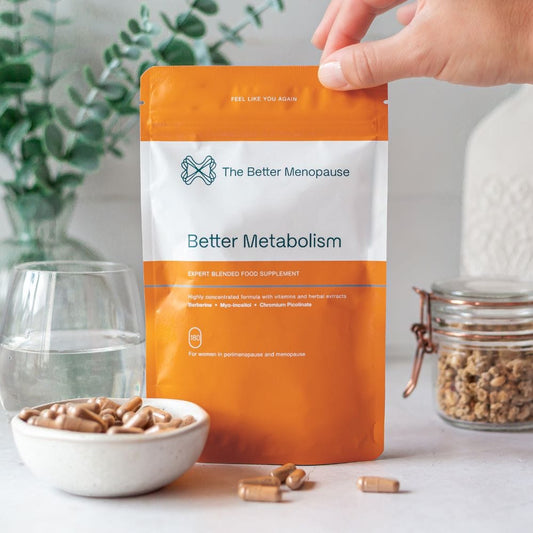
Better Metabolism