So you've worked out that you're in perimenopause. Maybe a GP confirmed it. Maybe you read our guide on the signs and stages and everything clicked. Maybe you just know, because your body has been telling you for months and you've finally started listening.
Now what?
This is the bit nobody covers. There's plenty of information about what perimenopause is, but far less about what to actually do when you're in it. Where do you begin when the list of possible symptoms runs to forty items and the advice ranges from "just exercise more" to "overhaul your entire life"?
The answer is simpler than you think. You don't need to change everything. You need to change the right things, in the right order, and give yourself time. This guide is your starting point.
Key takeaways
- Your gut microbiome directly affects how your body metabolises hormones. Supporting it is the foundation everything else is built on.
- You don't need to change everything at once. Start with gut health, sleep and protein, then build from there.
- Strength training is the single most valuable form of exercise during perimenopause. If you do nothing else, start lifting.
- Your gut microbiome directly affects how your body metabolises hormones. Supporting it is not optional.
- See your GP when you're ready. You don't need to wait until things are unbearable. Bring a symptom tracker.
In this article
The four foundations
When everything feels like it's shifting at once, the temptation is to try to fix everything simultaneously. New supplements, a new diet, a new exercise regime, all on a Monday. By Wednesday, you're exhausted and nothing has stuck.
Instead, focus on four things. These are the foundations that affect almost every perimenopause symptom, from sleep and mood to weight and energy. Get these right and everything else becomes easier.
- Gut health. Your microbiome directly affects how your body processes hormones. It's the foundation everything else is built on.
- Sleep. The multiplier. Poor sleep worsens every other symptom.
- Protein. Most women aren't eating enough. Increasing it supports muscle, metabolism, blood sugar and satiety.
- Movement. Specifically, strength training. It's the most valuable thing you can do for your body during perimenopause.
Pick whichever one feels most achievable right now and start there. You can layer in the others over time. Progress beats perfection every time.
Support your gut (it's the foundation)
Your gut microbiome isn't just about digestion. It plays a direct role in how your body metabolises oestrogen (via the estrobolome), regulates inflammation, produces neurotransmitters (including serotonin), manages immune function, and processes histamine. During perimenopause, hormonal changes can shift the balance of your gut bacteria, which in turn affects how well your body handles the hormonal transition.
This is why gut health comes first. It underpins everything else: your sleep, your mood, your energy, your weight, your immune system. Get your gut right and the other changes work harder.
What helps:
- Eat a diverse range of plants. Aim for 30 different plant foods per week (vegetables, fruits, wholegrains, legumes, nuts, seeds, herbs and spices all count). Diversity feeds diversity in your microbiome.
- Include prebiotic-rich foods. Oats, flaxseeds, garlic, onions, leeks, asparagus and bananas feed beneficial bacteria.
- Consider a targeted probiotic. Not all probiotics are the same. Choose one formulated for women during perimenopause, with clinically studied strains that support the gut-hormone connection.
- Reduce ultra-processed foods. They tend to reduce microbial diversity and promote inflammation.
- Manage stress. Cortisol directly impairs gut function. More on this below.
Our guide to the estrobolome explains the gut-hormone connection in more detail.
Your gut and your hormones are connected
Better Gut contains six clinically studied probiotic strains formulated specifically for women in perimenopause and menopause.
Protect your sleep
Sleep is the multiplier. When you sleep badly, your cortisol rises, your blood sugar is less stable, your appetite hormones shift (making you crave sugar and carbohydrates), your mood drops, your brain fog worsens, and your body's ability to repair itself is compromised. Fixing your sleep won't solve perimenopause, but not fixing it will make everything harder.
During perimenopause, sleep disruption is driven by hormonal changes (falling progesterone removes a natural sedative effect), hot flushes and night sweats, increased cortisol reactivity, and changes in your circadian rhythm. This means standard sleep advice ("just go to bed earlier") often isn't enough.
What actually helps:
- Keep your bedroom cool (16 to 18 degrees) and as dark as possible
- Stop caffeine after midday (your body processes it more slowly during perimenopause)
- Establish a consistent wind-down routine in the hour before bed
- Avoid screens for at least 30 minutes before sleep
- If night sweats are waking you, try layered bedding that you can easily remove
- Consider magnesium before bed (it supports muscle relaxation and nervous system function)
If sleep disruption is persistent and affecting your daily life, speak to your GP. There are effective treatments available, including HRT (which addresses the hormonal root cause) and CBT for insomnia. Our full guide to perimenopause and sleep covers this in more detail.
Eat enough protein
If there's one nutritional change that makes the biggest difference during perimenopause, it's eating more protein. Most women aren't getting enough, and the gap between what they need and what they're eating tends to widen during midlife.
Why it matters now: declining oestrogen increases muscle protein breakdown, reduces your body's ability to build new muscle, and makes blood sugar regulation less stable. Adequate protein counteracts all three. It supports muscle maintenance, stabilises blood sugar (reducing cravings and energy crashes), increases satiety, and provides the amino acids your body needs for repair.
How much: aim for 1.0 to 1.6g of protein per kilogram of body weight per day, spread across meals in portions of 25 to 30g. For most women, that means roughly 70 to 100g per day, depending on size and activity level.
What 25 to 30g looks like: a palm-sized portion of chicken or fish, three eggs, 200g Greek yoghurt with nuts, a tin of chickpeas, or 150g tofu with quinoa.
Start with breakfast. This is where most women fall short. Swapping toast or cereal for eggs, Greek yoghurt with seeds, or a protein smoothie can change the trajectory of your entire day. Our guide to protein in perimenopause goes deeper.
Supporting blood sugar and metabolism
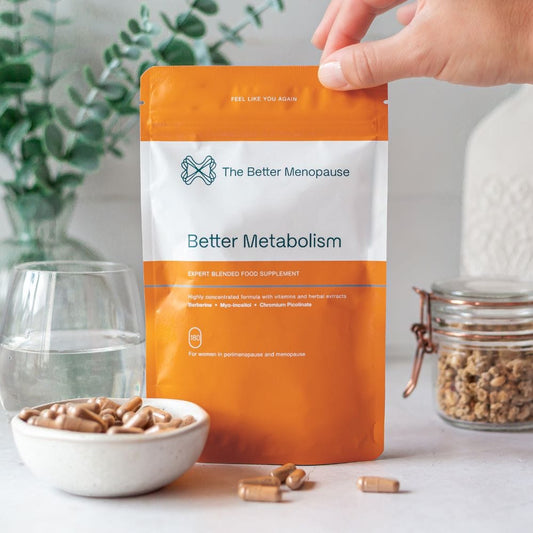
Alongside adequate protein, targeted supplementation can support metabolic function during perimenopause. Better Metabolism combines berberine, cinnamon, chromium and myo-inositol to support blood sugar balance, reduce cravings and help your body use energy more efficiently.
Move your body (but differently)
If you've been relying on cardio (running, spinning, HIIT classes) as your primary form of exercise, perimenopause is the time to rethink your approach. This isn't about doing less. It's about doing what your body actually needs right now.
Strength training is the priority. It's the single most valuable form of exercise during perimenopause, and the research is clear. It protects and builds muscle mass (which you're losing), supports bone density (which is declining as oestrogen drops), boosts your resting metabolic rate, improves insulin sensitivity, and has a direct positive effect on mood, confidence and sleep. Two to three sessions per week is enough to make a measurable difference.
If you've never lifted weights, start with bodyweight exercises or light dumbbells and build gradually. A personal trainer, even for a few sessions, can give you the confidence to know what you're doing. Many gyms offer introductory sessions for free.
Keep moving daily. Alongside strength training, aim for regular aerobic movement: walking, swimming, cycling, dancing. It doesn't need to be intense. Consistency matters more than effort. A daily 30-minute walk does more for your health than a punishing HIIT session once a week followed by four days on the sofa.
Prioritise recovery. Your body recovers more slowly during perimenopause. Give yourself rest days. Sleep well. Stretch. Listen to your body when it tells you to ease off. Pushing through exhaustion is counterproductive during this stage of life.
Manage stress (before it manages you)
During perimenopause, your stress response becomes more reactive. Oestrogen helps regulate cortisol, and as it fluctuates, the same stressor that wouldn't have bothered you two years ago can now trigger a disproportionate physical response: racing heart, shallow breathing, irritability, insomnia, digestive issues.
Stress management during perimenopause isn't a luxury. It directly affects your sleep, your gut health, your blood sugar, your weight, your mood and your immune function. Everything is connected.
What actually helps (not just "have a bath"):
- Daily movement. Even 20 minutes of walking reduces cortisol.
- Breathing exercises. Box breathing (4 counts in, 4 hold, 4 out, 4 hold) activates your parasympathetic nervous system. Two minutes can shift your state.
- Boundaries. Saying no to things that drain you is a health intervention, not selfishness.
- Time outdoors. Natural light and green spaces lower cortisol.
- Reducing caffeine and alcohol. Both increase cortisol reactivity during perimenopause.
- Connection. Talking to someone who understands. Not about finding solutions. Just about being heard.
What to reduce
This isn't about restriction or rules. It's about understanding that certain things hit differently during perimenopause, and adjusting accordingly.
Alcohol. Your body processes it more slowly, it disrupts sleep, destabilises blood sugar, increases cortisol and adds to your histamine load. You don't have to stop entirely, but reducing can produce noticeable improvements in sleep, mood and energy. Our guide to perimenopause and alcohol explains why.
Ultra-processed foods. These tend to be high in refined sugar, unhealthy fats and additives that reduce gut microbial diversity and promote inflammation. Swap where you can, not because you have to be perfect, but because your body responds to the quality of what you give it.
Caffeine after midday. Your ability to metabolise caffeine slows during perimenopause. An afternoon coffee that never used to affect you can now keep you awake at midnight.
Artificial sweeteners. Emerging research suggests many common sweeteners affect gut bacteria. Where possible, opt for naturally sweet foods or reduce your reliance on sweetness altogether.
Where supplements fit in
Supplements work best when they support a foundation of good nutrition, sleep and movement. They're not a replacement for those things, but they can fill gaps and provide targeted support where diet alone falls short.
During perimenopause, the supplements with the strongest rationale include:
- A targeted probiotic to support the gut-hormone connection and digestive health
- Magnesium for sleep, muscle function and nervous system support (many women are depleted)
- Vitamin D for bone health, immune function and mood (especially in the UK where sunlight is limited for much of the year)
- Omega-3 fatty acids for brain health, cardiovascular support and inflammation
- Supplements for blood sugar support (such as berberine, chromium and cinnamon) if cravings and energy crashes are a problem
Always choose supplements from reputable brands that use clinically studied ingredients and are transparent about what's in them. If you're taking medication, check with your GP or pharmacist before adding supplements.
Talking to your GP
You can see your GP at any point. You don't need to wait until symptoms are severe, and you don't need to have tried everything else first. A conversation with your GP can help you understand your options, rule out other conditions, and decide whether medical treatment (including HRT) is right for you.
Before your appointment:
- Track your symptoms for two to three months (what, when, how intense, any patterns linked to your cycle)
- Note how symptoms are affecting your daily life, work and relationships
- Write down what you've already tried and what's helped
- Prepare specific questions (about HRT, about blood tests, about referrals)
If your GP is dismissive, you have the right to ask for a second opinion or a referral to a menopause clinic. Your symptoms are real. You deserve to be taken seriously.
HRT (hormone replacement therapy) addresses the hormonal root cause of perimenopause symptoms and is the most effective treatment for many women. It's not right for everyone, and the decision is personal, but it's worth understanding your options. Your GP can talk you through the benefits, risks and different types available.
Related reading
- Am I in perimenopause? The signs, the stages, and what to do next
- Protein in perimenopause: how much you need and why it matters
- Why can't I sleep during perimenopause?
- The estrobolome: how your gut bacteria affect your oestrogen levels
- Perimenopause and alcohol: why you can't drink like you used to
- Perimenopause weight gain: why it happens and what actually helps
The bottom line
Perimenopause can feel overwhelming when you're standing at the beginning of it, looking at the full list of things you could or should be doing. But you don't need to do everything. You need to start somewhere.
Sleep. Protein. Movement. Gut health. These four things will change how you feel more than any single supplement, diet or viral trend. Build them into your routine one at a time, give yourself grace when it's not perfect, and know that the timing is on your side.
Research shows that perimenopause is actually the window when your body is most responsive to lifestyle changes. The choices you make now have a bigger impact than they will later. That's not pressure. It's opportunity.
Start where you are. Use what you have. Do what you can. And come back to this page whenever you need a reminder of what matters most.
Start with your gut
If you're looking for somewhere to begin, start with your gut. Better Gut contains six clinically studied probiotic strains formulated for women in perimenopause and menopause, supporting digestion, hormone metabolism and the gut-hormone connection.
Shop Better Gut →Discover our award-winning formulations
-
Regular priceFrom £40.00Regular priceSale priceFrom £40.00 Save £-40.00 (%)Unit priceper
Better Gut
-
Regular priceFrom £40.00Regular priceSale priceFrom £40.00 Save £-40.00 (%)Unit priceper
Better Metabolism
-
Regular priceFrom £40.00Regular priceSale priceFrom £40.00 Save £-40.00 (%)Unit priceper
Better Night
-
Regular priceFrom £30.00Regular priceSale priceFrom £30.00 Save £-30.00 (%)Unit priceper
Better Libido